|
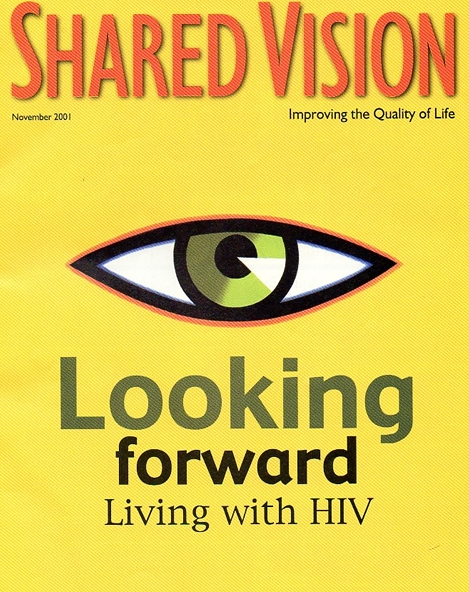 SHARED VISION Magazine Cover - Issue 159 - November 2001:
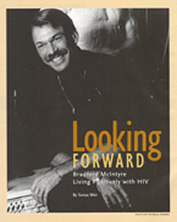
Looking forward Living with HIV. November 2001.
Art Images by Joe Average
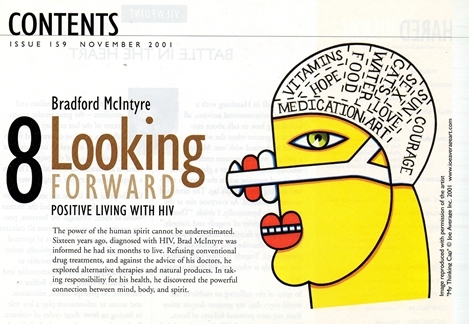 Art: Image: My Thinking Cap by Joe Averageart Inc.- Joe Average
Looking Forward
Bradford McIntyre
Living Positively with HIV
by Sonya Weir
Published in Shared Vision Magazine, Nov. 2001 Issue 159
 Shared Vision Magazine:
Looking Forward Bradford McIntyre Living Positively with HIV by Sonya Weir
- Shared Vision Magazine November 2001
The power of the human spirit cannot be underestimated. Sixteen years ago, diagnosed with HIV, Brad McIntyre was informed he had six months to live. Refusing conventional drug treatments, and against the advice of his doctors, he explored alternative therapies and natural products. In taking responsibility for his health, he discovered the powerful connection between mind, body, and spirit.
Sixteen years ago, on November 28, Brad McIntyre was advised to put his house in order, inform his family and friends, and make arrangements for his funeral. At the new *HIV/AIDS clinic in Hamilton, Ontario, a doctor had just informed him he was HIV positive with six months to live. In all of twelve minutes, his world was turned upside down.
Having been in a monogamous relationship with a man for almost a decade, Brad was stunned. “Never did I ntertain the thought of the test results coming back anything but negative.” Later, he wrote about his drive home to Kitchener: “At any time, I could take hold of the steering wheel and swerve right off the road. I distinctly remember this strong sense, while crossing a major bridge, to swerve out of control off the bridge. The water below would solve everything. I couldn’t go on or face what was ahead.” He has since become a tireless advocate for change and consciously celebrates his life every day. He doesn't wait for someday. “There is only one of us here and the time is now,” he says, expressing his belief in the connection that exists between all people and the power of the present moment.
In the early ’80s, there was essentially no treatment for AIDS other than AZT (chemical name: Azidothymidine, generic name: Zidovudine). Brad recalls that death came in different forms. “Opportunistic infections, pneumonia, and cancers were the most common but other illnesses were popping up as well.” AZT, Burroughs Wellcome's miracle drug, had been approved by the FDA (Food and Drug Administration) even faster than Thalidomide in the mid–’60s, giving it the dubious distinction of the drug most rapidly approved in their history. Originally developed as cancer chemotherapy, AZT had subsequently been shelved, proving too expensive, too toxic, and ineffective in treating cancer. Recalled as a wonder drug to fight AIDS, the side effects were horrendous. Sigma Co.’s labeling of AZT included the following: “Toxic by inhalation, in contact with skin and if swallowed. Target organ(s): Blood bone marrow. If you feel unwell, seek medical advice. (Show the label where possible) Wear suitable, protective clothing.”
According to Brad, there was a major problem with the research: “When Dr. Montanier in France announced that the HIV caused AIDS, the research was directed solely at attacking the virus using pharmaceuticals. I believe, as others do, that this limited the understanding of this disease and in turn affected the direction treatment took. We may have overlooked areas or been limited in our assumptions as to how the virus works. Because of the high dosages administered and the fact that it was entirely experimental, Brad refused to take AZT. Others infected with the virus were having positive results with Vitamin C, Beta Carotene, garlic, Glutamine, Ginseng, Ginkgo Biloba, Acidophilus, Shitaki mushrooms, Lecithin, and B12. Brad followed in their footsteps. In the ensuing sixteen years, he has taken AZT only intermittently, an amount of time equivalent to nine months. Describing his first treatment in 1990, he says: “The first six months were fine and then all hell broke loose.” Severe side effects included nausea, headaches, and Neuropathy, a deterioration of the nervous system in the legs, making walking almost impossible. He remembers barely managing the two stairs leading to the hair salon where he worked.
Early on, tremendous fear and misunderstanding led to talk of people being quarantined and the possibility of a government list naming all infected individuals. Even more worrisome was the question of what the government would do with such a list. As Brad says: “There was little understanding of a disease that seemed to be killing young gay men in their ’20's and ’30s with the stigma attached that this disease was deadly to anyone infected – a gay plague.” He was terrified that people would find out and worried that his family would suffer if they had to watch him die. Two and a half years later, Brad moved from Kitchener to Ottawa where no one knew him. For the next four years, he lived in fear and isolation in a home that began to feel like a cage. Today, he has a strong message for anyone diagnosed with HIV. “There’s more power in people knowing. Don't withdraw. It’s important to tell people. I wouldn't be where I am today if it weren’t for all the people in my life.” He adds, “There are shelves in closets for just about everything, including being gay, drug abuse, and alcoholism.”
He has a lot of gratitude for Marilyn, his AIDS counselor in Ottawa, who opened the door to healing for him. “Because no one knew I was HIV positive, she gave me an exercise to do. I was to ask or let someone do something for me and find those persons I could tell. That was the beginning.” He also shares an inexplicable experience with a client at his hair salon who knew nothing of his circumstances. She sat down in his chair one day and announced: “I came here to tell you that you’ve suffered long enough and it’s time to get on with your life.” Although, he was never to see her again, he took her words to heart.
Although attitudes towards alternative therapies have changed considerably over the years, when Brad was diagnosed, there was virtually no support for anything other than prescribed drugs. One doctor went so far as to state: “People who do alternative therapies die.” But Brad didn’t plan on dying. Embarking on a course of self-healing, he changed his diet to live foods and juicing and practiced visualization and meditation. He saw a Reiki practitioner, studied A Course in Miracles and later underwent ozone and oxygen therapies. “I was in a hurry to feel good,” he says, “because I had felt so bad and didn’t know how much time I had. In that hurried state, the tools that showed up, I adopted as fast as I could.” He came to understand the mind/body connection and realized that through his guilt, fear, and hiding, he had been sending negative messages to his body’s cells. In repeating, “I&trsquoi;m afraid, I’m afraid, I’m afraid,” he was using his emotions against himself. He says simply: “I learned how not to do it.”
Brad acknowledges that doctors today no longer pronounce death sentences and alternative therapies are more widely accepted. But he has watched too many friends die after being informed they had six months to live. His own death sentence was extended many times as he lived past each predicted demise. He says that the will to live is powerful and should never be ignored. “Many people have found the strength to combat their illness, take responsibility for their lives, and make changes that create wonderful, new benefits to their physical health.” He also believes that “Our immune system is one of the best disease fighters on the planet.” Over the last ten years, Brad’s doctors have said that although they don’t know what he’s been doing, whatever it is, he should keep doing it. And he does. He talks about the benefits of moderate exercise and its immune boosting endorphins. He cautions against excessive exercise, likening it to just another form of stress. He adds, “Diet is key.”
Brad says that HIV still creates fear in people who know he’s infected, prompting him to state: “I’m not HIV, I’m Brad. I’m a person.” Dispelling the prevailing myth that AIDS is a ‘gay disease’, he cites current statistics, noting that 75 percent of the world’s AIDS population is, in fact, heterosexual and 62 percent are women. Tragically, the largest growing group of people infected is young girls between the ages of 11 and 15. He notes that Canada lags well behind Europe in support for alternative methods like ozone therapy. While no research funding exists in Canada, European doctors have been involved for the last 40 years. He thinks Vancouver is amazing, however. He moved here in 1995, six months after being overwhelmed during his two–month visit by the acceptance of therapies like body rebalancing and cranial-sacral — practices he had never heard of. The network of people working with alternative and natural methods astounded him. During that visit, while standing on the Burrard Bridge overlooking the water, he had the realization that he was to return to Ottawa and avail himself to the media as a vehicle for change. He knew that he had to provide information to help others. “The response,” he says, “wasn't something I expected.”
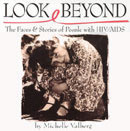 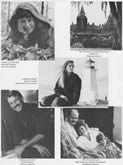 In 1994, he publicly announced that he had been infected with HIV since 1984 and was still healthy. He put out a pamphlet providing information on alternative therapies. For his November 28 anniversary, he organized a huge 'Celebration of Life' at Ottawa's World Exchange Plaza. He was approached by Michelle Valberg to participate in and be photographed for her book Look Beyond: The Faces & Stories of People with HIV/AIDS dedicated to Canadians living with HIV/AIDS. On World AIDS Day in 1994, he appeared on the Dini Petty Show in Toronto. He joined the Board of Directors of Ottawa's Snowy Owl AIDS Foundation. He made numerous appearances, wrote articles, and sent countless letters to the government, beseeching them to provide proper health care, nutrition, funding for alternative therapies, and subsidized housing for those infected with HIV. He shed light on the medical profession's tendency to automatically assume that the virus caused all HIV patients’ medical problems. He cited studies with healthy animals, proving that when subjected to constant fear and stress, they surrendered the will to live – like the thousands of HIV patients who had died after being handed their death sentences. He implored science to start looking at the possible multiple causes of the disease, including water and air pollution; food quality; overuse of antibiotics; stress; drugs and alcohol; smoking; and sexually transmitted diseases. His commitment to increase awareness about the disease was unwavering. In 1994, he publicly announced that he had been infected with HIV since 1984 and was still healthy. He put out a pamphlet providing information on alternative therapies. For his November 28 anniversary, he organized a huge 'Celebration of Life' at Ottawa's World Exchange Plaza. He was approached by Michelle Valberg to participate in and be photographed for her book Look Beyond: The Faces & Stories of People with HIV/AIDS dedicated to Canadians living with HIV/AIDS. On World AIDS Day in 1994, he appeared on the Dini Petty Show in Toronto. He joined the Board of Directors of Ottawa's Snowy Owl AIDS Foundation. He made numerous appearances, wrote articles, and sent countless letters to the government, beseeching them to provide proper health care, nutrition, funding for alternative therapies, and subsidized housing for those infected with HIV. He shed light on the medical profession's tendency to automatically assume that the virus caused all HIV patients’ medical problems. He cited studies with healthy animals, proving that when subjected to constant fear and stress, they surrendered the will to live – like the thousands of HIV patients who had died after being handed their death sentences. He implored science to start looking at the possible multiple causes of the disease, including water and air pollution; food quality; overuse of antibiotics; stress; drugs and alcohol; smoking; and sexually transmitted diseases. His commitment to increase awareness about the disease was unwavering.
In 1998, Brad developed PCP, a form of pneumonia related to the HIV virus, which proved to be life threatening. After having come so far, he agreed to a ‘drug cocktail’, which included the new Protease Inhibitors, effective in preventing the virus from replicating. For the next two years, the treatment was fairly successful. Two years later, Brad’s Genome test determined that he was resistant to almost all available drugs, including some he had never taken. At the same time, Brad enrolled in a study on a new drug, ABT 387-R. In only four weeks, his immune system was boosted. Brad says that people are benefiting from the drugs prescribed today. There are side effects like elevated cholesterol levels, hardening of the arteries, and heart attacks, but as his doctor told him: “This is the price of staying alive.”
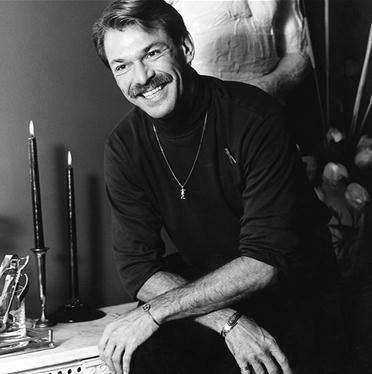
 Bradford McIntyre Bradford McIntyre
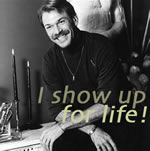
As of this year, the virus cannot be detected in Brad’s body. With not one viral particle to be found, it means, as Brad gratefully acknowledges, “there is a possibility of a miracle.” In her book, Look Beyond, Michelle has caught Brad’s irrepressible spirit in a photograph. With more energy than most people, he continues to “show up for life,” something he strongly encourages everyone to do. He swims, works out in the gym, rides a bike, and flies a kite. He believes that everything always works out, saying: “My life is about trust.”
Resources:
Look Beyond, The Faces & Stories of People with HIV/AIDS, by Michelle Valberg. Available at Little Sister's Book & Art Emporium, 1238 Davie St., 604-669-1753. All proceeds to Snowy Owl AIDS Foundation.
Source: Shared Vision November 2001
* Shared Vision Magazine ceased publishing in 2009.
SHARED VISION Magazine
Wayback Machine Web Archive:
Looking Forward Bradford McIntyre Living Positively with HIV
|