|
December 5, 2025
World AIDS Day 2025: Urgent Call to Action:
On December 1, 2025, advocates and health experts warned that global HIV/AIDS funding cuts threaten decades of progress, putting millions of lives at risk. In this article, Bradford McIntyre, long-time HIV survivor and international advocate, shares his perspective on the ongoing challenges, the role of community-led initiatives, and expert insights—including comments from Dr. Julio Montaner, Executive Director of the BC Centre for Excellence in HIV/AIDS. This piece serves as a call to action for governments, communities, and individuals to ensure sustained investment in HIV prevention, treatment, and support.
World AIDS Day 2025 Was a Call to Action
A 2004 Call for Action Still Rings True
By Bradford McIntyre
Vancouver, BC, Canada – December 5, 2025 — World AIDS Day, observed each year on December 1, offered a moment to reflect on both the progress made and the challenges that remain. It was also a day to recognize the 44.1 million lives lost to AIDS and the 40.8 million people living with HIV.
More than four decades into the epidemic, advances in treatment have transformed HIV from a fatal diagnosis into a manageable condition for many. Yet too many people still face barriers to testing, care, and prevention—often because of stigma, inequality, or limited access to essential health services. As we marked World AIDS Day 2025, the call to action felt more urgent than ever.
A Personal Journey
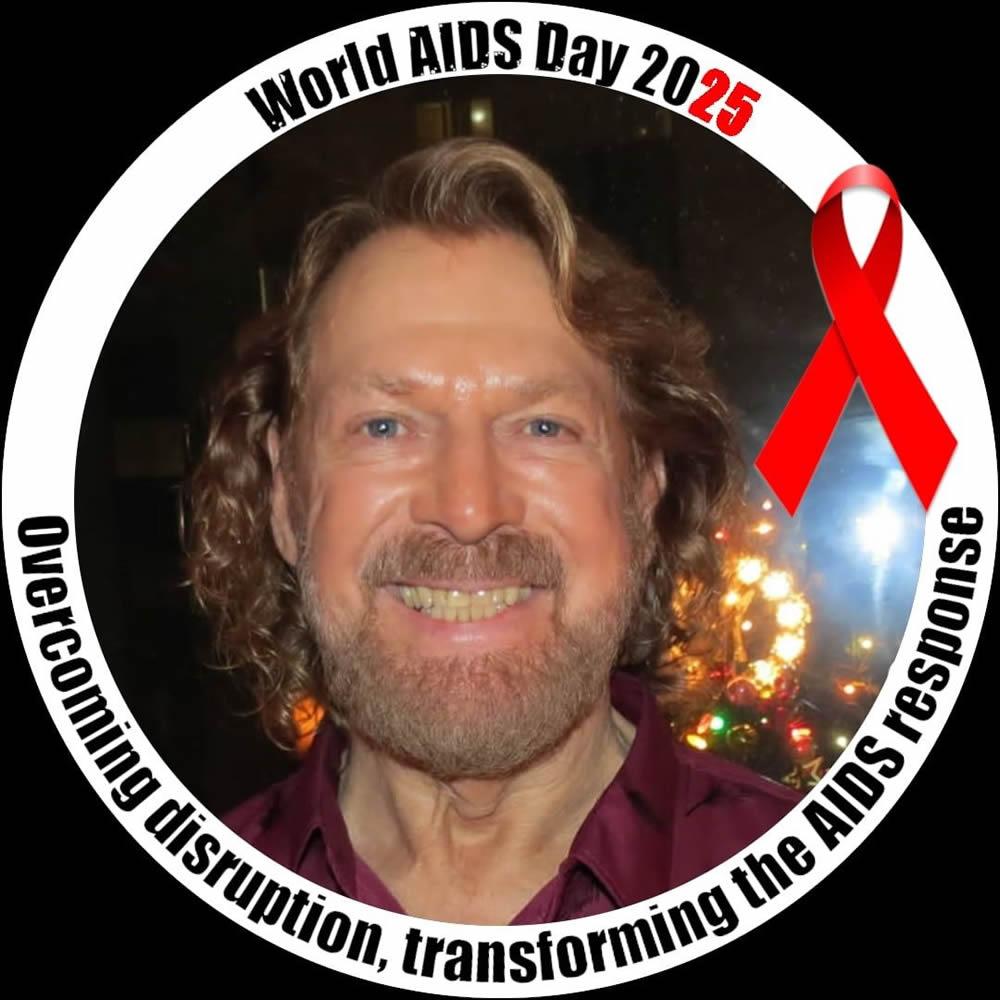
Profile Frame:
WORLD AIDS DAY 2025 Overcoming disruption, transforming the AIDS response Photo: Bradford McIntyre, living with HIV since 1984.
Profile Frame of Bradford McIntyre by Mark Janes
In the early years, an HIV diagnosis was a death sentence. When I learned I was living with HIV in 1984, I clung to one hope: if I could survive ten years, perhaps better treatments would emerge. When I reached that milestone, I dared to hope I might even live to see the end of AIDS.
Now, 41 years later, I am still here—on treatment, undetectable since 1998, with a recent CD4 count of 1310. My continued health is the result of reliable access to HIV treatment. But already, people are losing that access. People living with HIV—and many HIV long-term survivors like me—are facing these challenges firsthand.
Given the current situation in Canada, with planned cuts to health care and global AIDS funding, I cannot help but ask: will I—and others like me—be able to live out our lives?
My journey into advocacy began with a simple intention: to make sure other people living with HIV wouldn’t have to experience what I—and so many before me—went through. In the early years of the epidemic, fear, misinformation, and stigma shaped nearly every interaction, often causing more harm than the virus itself. Over time, I learned that sharing my story could open doors for others, challenge misconceptions, and help build the compassion and understanding that people living with HIV deserve.
My advocacy is rooted in that history, but it is also driven by hope: hope that the next generation will inherit a world where living with HIV is met not with judgment or silence, but with dignity, support, and access to life-saving care.
A Global Crisis in Funding
Decades of progress in fighting HIV, tuberculosis, and malaria are now under threat. Without sufficient funding for infectious disease prevention and treatment, we are entering a dangerous period for global public health.
Under the Trump administration, the U.S. government reduced support for federal programs and global aid, interfering with initiatives that had been making measurable progress in HIV prevention, education, and treatment. Estimates suggest that the 2025 cuts to USAID programs may have contributed to as many as 600,000 deaths, including children.
Adding to the irony, just days before World AIDS Day, the U.S. government canceled funding for the observance itself.
The consequences of these reductions are being felt worldwide. On December 1, 2025, UNAIDS Executive Director Winnie Byanyima urged Canadian Prime Minister Mark Carney to reconsider his government’s planned cuts, highlighting the growing concern that decreased funding is creating a global crisis. Around the world, reduced investments in HIV programs threatened to reverse decades of progress and left millions without access to essential services.
In response to the growing crisis, Dr. Julio Montaner, Executive Director of the BC Centre for Excellence in HIV/AIDS, emphasized the urgency of the situation, noting that:
“Against this devastating crisis, we must demand more from our Political Leaders. Indeed, Canada must urgently fund Treatment as Prevention (TasP) of HIV/AIDS, including HIV treatment and Pre-Exposure Prophylaxis (PrEP) within Pharmacare for all, and enhance social and medical supports for priority populations at greatest risk. Next, we need frequent centralized reporting of progress towards the 2030 UN Targets, while enhancing phylogenetic monitoring to better address hotspots of transmission.”
“Then, we must address the over-criminalization of HIV transmission, and harmonize risk reduction policies across the country, to remove stigma that prevents people from accessing treatment. Finally, we must increase funding to global efforts to control HIV/AIDS, including the Global Fund, as HIV knows no borders. Make no mistake, the lack of current investment on HIV/AIDS control will cost us in the long-term We either pay now or pay more later. Funding a national TasP + PrEP strategy now protects Canadians, as it saves lives, prevents new infections, and saves money. With the Canadian health care system under unprecedented stress, there should be no greater urgency.”
A 2004 Call for Action Still Rings True
In my 2004 article “AIDS Is a War Against Humanity,” published by PAMBAZUKA NEWS, in Africa, I warned that neglecting people living with HIV and failing to provide adequate funding would have “an enormous effect on all our lives,” asking, “When will our eyes be opened to what is going on all around us?” Two decades later, those words feel painfully relevant as today’s global funding cuts threaten to undo hard-won progress and place millions of lives at risk.
Communities Leading the Way
Despite these challenges, community-led organizations remain at the heart of the global response. Peer educators, advocacy groups, and grassroots health workers were often the first—and sometimes the only—links between vulnerable populations and the care they needed.
These programs did more than provide services: they challenged stigma, advocated for human rights, and built the trust essential for effective health interventions. It was this lived experience—from people directly affected by HIV—that drove the movement forward and underscored why community leadership remains essential.
A Call to Action
The cuts to global health funding are not just numbers on a spreadsheet—they were lives at risk. Reductions in aid affected people living with infectious diseases such as HIV, tuberculosis, and malaria, leaving millions without access to treatment, prevention, or support. Already, people are dying because essential medications and services aren't available.
If the world does not act quickly to restore and increase funding, the situation could become far worse than it was 45 years ago, when the HIV epidemic began. It took decades for the number of people living with HIV and AIDS to reach 40.8 million—but without urgent action, the next 45 million infections could come far faster.
For those of us who have lived with HIV for decades, this moment is painfully familiar. Many HIV long-term survivors—including original members of ACT UP—mobilize once again alongside millions of people around the world. Despite ongoing health challenges, we were called into action once more, driven by the same urgency that shaped the early response to HIV.
Everyone has a role to play—speaking up, organizing, and joining together to urge government officials to restore and expand funding for HIV programs, both in Canada and around the world.
The message is clear: progress is fragile, lives are on the line, and the time to act was now. Without bold and sustained investment in global health, the gains of the past 45 years risked being erased—and millions more could suffer unnecessarily.
A Message of Unity and Hope
I am an HIV advocate, promoting awareness of HIV and AIDS, and it will take all of us to stop HIV. We are all connected!
“Whether you are affected by HIV or living with HIV, we must cross the boundaries of fear and discrimination and join our hearts in the understanding that we are all here to love and support one another. I stand with you in creating a shift in thinking around HIV/AIDS—and all disease.” — Bradford McIntyre
This is the spirit that drove the global fight against HIV. On World AIDS Day 2025, we reflected on the past, acted in the present, and were reminded that working together is the only way to ensure a healthier, more equitable future for all.
Author Bio
HIV positive Canadian Bradford McIntyre promotes HIV and AIDS awareness
and messages of positive living with HIV.
–Advocate – Writer – Speaker – Volunteer – Researcher –
Founder: Bradford McIntyre Positively Positive Living with HIV/AIDS
(www.PositivelyPositive.ca)
DESIGNED TO CREATE HIV and AIDS AWARENESS
Bradford McIntyre is a long-time HIV survivor, diagnosed in 1984, and an internationally recognized advocate for people living with HIV. On World AIDS Day, December 1, 1994, Bradford publicly disclosed his HIV status on national TV, on The Dini Petty Show, becoming a visible and compassionate voice in the global HIV community. Over the past three decades, he has appeared on national television and radio, in numerous newspaper and magazine interviews, documentaries, and national and international speaking engagements. Bradford has also contributed to a number of research papers and studies, as well as participated in clinical trials aimed at improving HIV treatment and the quality of life for those living with the virus.
Bradford has served on the Boards of Directors of several prominent AIDS Service Organizations, including the Snowy Owl AIDS Foundation (Ottawa), the Face Forward Foundation (Toronto), and AIDS Vancouver. Since 1994, he has consistently volunteered his time, energy, and voice to support HIV and AIDS causes, events, and initiatives that promote awareness. Bradford's global impact is shown through his comprehensive, informative website, Bradford McIntyre Positively Positive Living with HIV/AIDS (www.PositivelyPositive.ca), which is a widely recognized resource designed to raise awareness about HIV and AIDS issues and promote messages of positive living.
Contact:
Bradford McInytre
www.PositivelyPositive.ca
Designed to Create HIV/AIDS Awareness
604-688-7702
bradford@positivelypositive.ca
Vancouver BC, Canada
Back to ...
Positively Positive - Living with HIV/AIDS:
HIV/AIDS News
For more HIV and AIDS News visit...
Positively Positive - Living with HIV/AIDS: HIV/AIDS News Archive
|