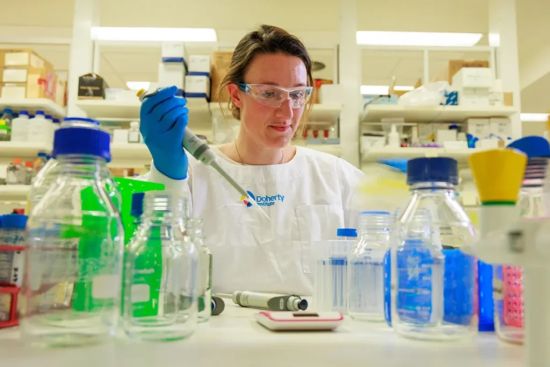
A Melbourne-based HIV cure research team has received $1.2 million to continue their breakthrough mRNA-based approach first reported in 2025, which made international headlines.
Last year, the team at the Peter Doherty Institute for Infection and Immunity used mRNA embedded with a special message that targets HIV telling it to wake up. While it’s only been tested in the lab, the theory is that once this sleeping HIV is woken up, the immune system may be able to help clear those cells harbouring HIV.
People would continue taking antiretrovirals (ARVs) to stop HIV spreading, giving the immune system a chance to clear the virus as it is exposed. Over time, HIV would be reduced to a point that our immune system can easily mop up any remnants of the virus. We’d then stop taking our ARVs. This mRNA breakthrough from Melbourne made world headlines last year, some were quite sensationalist, which had many thinking a cure had been found.
One of the lead researchers on the team, Dr Paula Cevaal advised that this mRNA HIV cure research is still very much in the lab using donated blood and tissue samples from people living with HIV and is still at an early stage and likely several years away from clinical trials in people.
“And unfortunately, the reality is that many drugs appear very promising in lab-based testing, but for various reasons don’t manage to reach clinical trials in people,” Paula adds.
The $1.2 million was received from the National Health and Medical Research Council’s IDEAS Grants Scheme and will help advance this mRNA research.
“But this new funding allows us to continue refining our approach. The two key questions we are asking are: can the therapy wake up all HIV, not just a portion of it? And once revealed, will those cells with HIV inside actually be cleared? If we can only wake up 20 per cent of the virus, there’s no point. And if revealing it doesn’t lead to it being cleared, then there’s also no point progressing,” Paula says.
Why our ARVs can’t reach HIV in hiding
For people living with HIV, modern antiretrovirals (ARVs) can suppress the virus to undetectable levels and allow people to live long, healthy lives, but ARVs don’t get rid of it.
What scientists call the HIV reservoir is central to this challenge.
Paula explains: “The reservoir is essentially the HIV that is still hiding in your body even when antiretroviral therapy has suppressed the virus to undetectable levels. Treatment is doing exactly what it should—keeping people healthy and preventing transmission—but there are parts of HIV that are still present.”
It hides by inserting itself into the DNA of certain immune cells, forming a reservoir the body can’t detect. This is why, if treatment stops, the virus rebounds—often within weeks. Some of these cells hiding HIV are extremely long-lived, surviving for years or even decades.
“As soon as you stop taking your treatment, this hidden HIV can come back,” Paula explains. “And that is why people with HIV have to take medication lifelong.”
For decades, scientists around the world have been trying to find a safe way to eliminate this hidden virus or HIV Reservoir. A true cure would mean removing the reservoir entirely—so people could stop treatment without the virus returning.
The mRNA breakthrough
Many people first heard about mRNA during the COVID-19 pandemic, but it’s something our bodies use constantly. This new approach using mRNA will deliver a powerful protein that targets HIV directly inside cells.
Paula explains that mRNA is really a messenger molecule. ‘It passes on different instructions within our cells—what to do every minute of every day.”
Crucially, mRNA is temporary. It’s almost like a single-use message. Once the instructions are delivered, the message disappears. It doesn’t change your DNA and doesn’t make any other permanent changes to your cells. It just tells the cell: ‘Today, I would like you to do this’. And in this case, the mRNA carries instructions to produce Tat, an HIV protein that acts like an “alarm bell” waking up HIV, so it can be seen.
Latency reversal or ‘waking up the virus’
In science terms, the strategy is known as latency reversal, or more simply: waking up the virus.
Researchers package the mRNA inside ‘lipid nanoparticles’ – or tiny fat bubbles – to protect it, because mRNA is very fragile and needs to be kept intact to reach those cells where HIV is hiding in deep slumber. Wrapped in a layer of fat, this allows the mRNA to avoid destruction by enzymes or the immune system along the way.
This is the latency reversal step. But the next step is just as critical: destroying those newly visible cells with active HIV. When the sleeping HIV turns back on and begins making more copies of itself, it has revealed itself to the immune system.
“Generally, the body is able to kill HIV,” Paula says. “But it’s just not good enough to do this when the virus is multiplying very quickly.” In other words, it needs a little help.
This is why ARVs are so important. ARVs will stop the awakened virus from spreading by slowing its multiplication – giving our immune system a chance to safely clear the cells that contain HIV.
“In a clinical trial, if we get this far, we therefore want people to continue taking their HIV treatment,” Paula explains. “This protects healthy cells and allows the immune system to do its job. And over time, the hope is that repeated cycles will shrink the reservoir—potentially to zero.”
Safety and side effects
As with any new therapy, safety is a major focus. mRNA treatments can trigger immune responses, sometimes causing flu-like symptoms like those seen with COVID vaccines. And there is also some scepticism from the public about mRNA and its safety.
“Every therapeutic comes with some risk,” Paula says. “What we need to determine is whether it’s safe enough compared to the benefit.”
So far, mRNA’s temporary nature is reassuring. It doesn’t enter the cell nucleus or alter DNA. But much more testing is needed, particularly in animal studies, before human trials can begin.
A global race to unlock HIV latency
Melbourne researchers are not alone in discovering how mRNA can wake up dormant HIV. This work is part of a broader global effort. At the recent 2026 Conference on Retroviruses and Opportunistic Infections (CROI) in the US, researchers from the University of Pennsylvania presented similar mRNA-based work. After lab success, they tested the approach in mice and monkeys— where waking the virus was followed by a reduction in infected immune cells.
“That’s incredibly exciting,” Paula says. “It gives us hope that what we’re doing is likely to work.”
Other teams, including researchers in Belgium, are also pursuing similar strategies, she adds.
But she warns we should not get too excited too quickly. Caution remains essential.
“We’re not there yet. There’s a long way to go,” Paula says.
How the mRNA HIV cure therapy might be delivered
If successful, this mRNA cure therapy would likely be given as an injectable—possibly monthly over several months. The aim would be a therapy that is scalable and accessible globally, including in low-income countries where the majority of people living with HIV reside. And the good news is that the COVID-19 pandemic demonstrated that mRNA technologies can be distributed worldwide, with infrastructure like freezers to store the injections until given improving significantly in many regions.
How this research is benefiting everyone
mRNA technology is now being explored far beyond HIV, including in cancer therapies, vaccines, and genetic diseases. Advances in these areas could accelerate progress, reduce costs and save lives. But for HIV, the journey toward a cure has always been gradual. After all, science has been at this for more than 40 years.
“I don’t want to generate false hope,” Paula says. “But there is a lot of excitement amongst HIV researchers.”
Even though this appears to be a breakthrough, such breakthroughs can fizz out. It’s happened many times before. So, what keeps scientists like Dr Paula Cevaal going, even after decades of setbacks?
“It’s the community itself,” Paula says. “It’s not just a medical problem. It’s about people, human rights, advocacy and working together to make a difference.”
How to get involved in HIV cure research
If you’re interested in donating blood and tissue samples for this mRNA HIV cure research, sign up to the Vitoriacn HIV Cure volunteer database. Even if you don’t live in Victoria, sign up anyway to receive regular updates on developments in HIV cure science and participate in surveys. There may also be opportunities for people in other states to donate blood as the research progresses.
Positive Living magazine will also keep you informed as we follow this exciting HIV cure research and bring you the latest updates as it happens.
Victorian HIV CURE volunteer form
HIV Cure website
Read past issues of the HIV Cure Volunteer newsletter
Save the Date and come to the ASHM HIV cure pre-conference
11.30am–5.30pm, Sunday 13th September 2026
Including keynote speaker Professor Sharon Lewin and Science for Community Symposium followed by canapes and networking.
This article was first published by the National Association of People with HIV Australia (NAPHWA). Read the original article.
Contact
Vimbai Chinembiri
Communications and Media Officer
M +61 (0) 413 747 345 | Media Line +61 3 8344 1911
E v.chinembiri@unimelb.edu.au
doherty.edu.au
Source: https://www.doherty.edu.au/articles/waking-hiv-from-its-secret-hiding-places/
"Reproduced with permission - Doherty Institute"
Doherty Institute
Back to ...
Positively Positive - Living with HIV/AIDS:
HIV/AIDS News
For more HIV and AIDS News visit...
Positively Positive - Living with HIV/AIDS: HIV/AIDS News Archive