President’s Medal honors biomedical researchers who developed lifesaving HIV medications
By Mary Loftus May 7, 2026
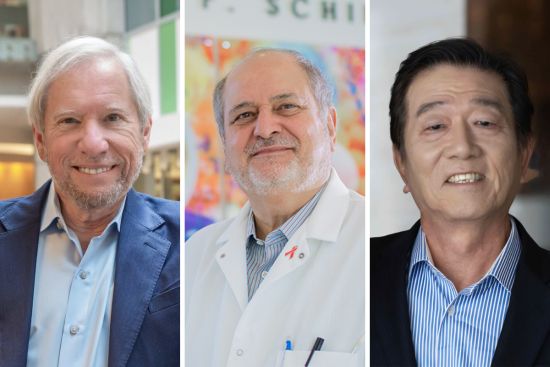
More than 90% of people in the United States living with HIV — and millions worldwide — have taken at least one of the medications developed at Emory by Dennis Liotta, Raymond Schinazi and Woo-Baeg Choi.
Scientists rarely hear directly from the people whose lives they have saved or improved.
And yet, Dennis Liotta, Raymond Schinazi and Woo-Baeg Choi have had that experience. The three biomedical researchers developed key HIV antiretroviral medications that helped transform HIV from a fatal disease to a manageable condition, saving millions of lives worldwide.
“Being approached by HIV/AIDS survivors who thank me is powerful and humbling,” Liotta says. “When someone tells me, ‘I’m on that drug and it changed everything,’ or ‘You saved my son’s life,’ it makes the science feel deeply personal.”
At Emory’s 2026 Commencement, Interim President Leah Ward Sears will award the President’s Medal to Liotta, Schinazi and Choi in recognition of a collaboration that reshaped global public health.
Liotta, the Samuel Candler Dobbs Professor of Chemistry at Emory, Schinazi, the Frances Winship Walters Professor of Pediatrics at Emory, and Choi, founder and president of FOB Synthesis, met at Emory.
Liotta and Schinazi were introduced by Dr. Jack Arbiser, then in his senior year studying chemistry at Emory, who believed they should collaborate; Choi was a postdoctoral research associate in Liotta’s lab at the time.
“Some of it was serendipitous,” says Liotta. “But we like to think of it as being in the right place at the right time — or, as Pasteur famously said, ‘Chance favors the prepared mind.’”
For Schinazi, the urgency was impossible to ignore. “When HIV came along, I was working in a clinic,” he recalls. “My lab was next door to patients with HIV, and you could see them outside the door, dying slowly. That leaves a tremendous impact and motivates you to find a solution to the problem. Putting the clinicians and PhDs side by side is so important.”
In the early 1990s, the team announced the discovery of two groundbreaking antiviral compounds: emtricitabine (FTC), later marketed as Emtriva (the “Em” stands for Emory), and lamivudine (3TC), marketed as Epivir. Both are nucleoside reverse transcriptase inhibitors, a class of drugs that blocks specifically the enzyme HIV uses to replicate.
The drugs did more than just expand options — they reshaped HIV therapy by making combination drug treatment more effective, tolerable and easier. Many with HIV were able to go from a handful of pills to just one pill a day.
The impact was profound. More than 90% of people in the United States living with HIV — and millions worldwide — have taken at least one of these drugs as part of life-saving treatment regimens. They are widely used all over the globe for the prevention and treatment of HIV, including maternal-fetal transmission.
The path to discovery was anything but straightforward. In the 1980s, when Liotta first chose to pursue HIV/AIDS treatments as a young Emory professor, some colleagues warned that a small academic lab could not compete with large pharmaceutical companies. He persisted anyway.
Schinazi’s motivation was equally personal. Born in Egypt, he witnessed firsthand the life-saving power of medicine when his mother nearly died from a fungal infection before a drug brought from abroad saved her life. “I thought, how fantastic that a simple drug like this can actually cure somebody,” he says.
Choi’s contribution highlights the value of a fresh perspective. Trained in chemistry but new to nucleosides, he approached a key step in making FTC without any built-in assumptions. By using a completely novel strategy, he achieved a much higher yield of the correct form of the molecule, which proved critical to the drug’s development.
“It turned out, the very first compound we made and the third compound we made led to FDA-approved drugs,” Liotta says. “Drug development is a team sport.”
Choi carried his experience into the private sector, first as a process chemist at Merck and, later, as the founder of FOB Synthesis in Atlanta, a company that focuses on antibiotic drug discovery and custom chemical synthesis.
Liotta and Schinazi remain active at Emory, continuing to lead research teams, author publications, secure patents, mentor young scientists and develop new drug therapies.
“I still speed to work every day, and I love it,” Liotta says. “I want to make the world a better place, and the way I can do that is by identifying unmet medical needs and finding solutions to address those.”
Their work has expanded into treatments for cancer, hepatitis C, liver disease and emerging viral threats, among others. Through initiatives such as forming Emory start-ups and creating the Emory Institute for Drug Development and Drug Innovation Ventures, they have helped build a pipeline that translates academic discoveries into real-world medicines, while advocating for broader global access.
“The goal is not just to make drugs, but to make drugs that are accessible so the people who need them can actually get them,” says Schinazi. “A drug that sits on the shelf helps nobody.”
Contact
Jacqueline Lee
Media Relations Coordinator
Communications and Marketing
jacqueline.n.lee@emory.edu
404-670-9606
Source: Emory News Center - Emory University
https://news.emory.edu/stories/2026/05/er_commencement_presidents_medal_07-05-2026/story.html
"Reproduced with permission - Emory University"
Emory University
Back to…
Positively Positive - Living with HIV/AIDS:
HIV/AIDS News
For more HIV and AIDS News visit…
Positively Positive - Living with HIV/AIDS: HIV/AIDS News Archive
|