Semen facilitates infection with Monkeypox virus
08/31/2026
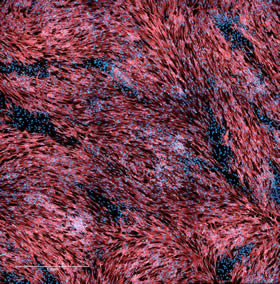 Connective tissue cells (fibroblasts; the blue cell nuclei are visible) in a cell culture were almost all infected by monkeypox viruses after one day if the viruses had previously been incubated with seminal fluid. Torbica et al., Emerging Microbes & Infections (2026) Connective tissue cells (fibroblasts; the blue cell nuclei are visible) in a cell culture were almost all infected by monkeypox viruses after one day if the viruses had previously been incubated with seminal fluid. Torbica et al., Emerging Microbes & Infections (2026) Study by Goethe University and Universitätsmedizin Frankfurt: Fibrous proteins in seminal fluid facilitate viral uptake
Monkeypox virus used to be transmitted predominantly from animals to humans. In recent years, however, new virus variants have become increasingly capable of spreading from person to person. Researchers at Goethe University and Universitätsmedizin Frankfurt have now found that seminal fluid facilitates the uptake of monkeypox virus into cells.
FRANKFURT. The World Health Organization (WHO) has declared a public health emergency of international concern twice in recent years because of mpox outbreaks, most recently in 2024. In fact, infections with the monkeypox virus are comparatively rare. However, in 2023, a virus variant emerged that infected around 100,000 people in several African countries in the first half of 2024 alone and killed more than 200, primarily children and immunocompromised individuals. There have also been infections in Europe and Asia, and new mpox cases continue to occur in Germany to this day, albeit at a low level.
The disease is usually mild and begins with rather nonspecific symptoms such as fever, headache and joint pain. The characteristic pox-like lesions on the skin do not appear until later. Since these can also occur on mucous membranes, they are sometimes detected only at a late stage. Earlier virus variants were transmitted predominantly from animals to humans, whereas newer variants also spread from person to person. Infected individuals become contagious with the onset of the first symptoms, but transmission requires close physical contact, for example when a mother hugs her child, or through sexual contact.
Researchers worldwide are investigating which factors might facilitate this efficient spread between people. A research team led by Professor Denisa Bojkova at Goethe University and Universitätsmedizin Frankfurt has now found that seminal fluid can facilitate infection of skin cells with the monkeypox virus. To investigate this, the researchers infected connective tissue cells (fibroblasts) and epidermal cells (keratinocytes) with monkeypox viruses. When the viruses had previously been mixed with seminal fluid, this promoted uptake of the pathogen into the cells. An analysis of the seminal fluid showed that certain naturally occurring protein fragments are responsible for this effect. These fragments form fibers, thereby facilitating the attachment of the monkeypox virus to human cells.
“Our findings provide an explanation for why sexual contact carries a particularly high risk of transmission,” says PhD student Emma Torbica, who conducted the experiments. “Seminal fluid can therefore promote infection when, for example, it comes into contact with anal or genital mucous membranes where pox-like lesions have already formed but have not yet been noticed.”
Study leader Bojkova explains: “At the same time, the findings are also important for medical practice, because we were able to show that available antiviral drugs remain effective under these conditions. In addition, we found that an experimental compound can disrupt the infection-promoting structures and directly inhibit the virus as well. In the long term, this could open up new approaches to prevention.”
Contact:
Dr. Markus Bernards
Referent für Wissenschaftskommunikation | Science Communications
Büro für PR & Kommunikation | Public Relations Office
Leitungsbereich | University Administration
Goethe-Universität Frankfurt | Campus Westend
PA-Gebäude | Theodor-W.-Adorno-Platz 1
60323 Frankfurt am Main | GERMANY
Telefon +49 (0)69 798 12498
E-Mail: bernards@em.uni-frankfurt.de
www.forschung-frankfurt.de
Source: https://www.uni-frankfurt.de/en/newsroom/meldungen/pressemitteilungen/2026/sperma-beguenstigt-infektion-durch-mpox-viren
“Reproduced with permission - Goethe University Frankfurt”
Goethe-Universität Frankfurt
Back to…
Positively Positive - Living with HIV/AIDS:
HIV/AIDS News
For more HIV and AIDS News visit…
Positively Positive - Living with HIV/AIDS: HIV/AIDS News Archive
|