Cancer patients with HIV must travel farther than others to access clinical trials
By Christine Grashorn
September 30, 2026
For people living with HIV, the road to a promising cancer treatment can be longer than it should be, literally.
According to a new multi-institutional study, HIV-positive cancer patients face significantly longer travel times than cancer patients without HIV to receive chimeric antigen receptor T-cell (CAR-T) therapy, an experimental treatment that may help target cancer cells while resisting HIV infection.
The University of Notre Dame's Civic-Geospatial Analysis and Learning Lab (C-GALL) teamed up with researchers from the University of Pennsylvania, University of Notre Dame, H. Lee Moffitt Cancer Center and Research Institute, Virginia Mason Medical Center, University of Washington Positive Research, and Memorial Sloan Kettering Cancer Center to examine whether geography may create an additional barrier to accessing CAR-T clinical trials.
CAR-T therapy, which uses engineered white blood cells (T-cells) to recognize and target cancer cells, has transformed treatment for patients with relapsed or refractory non-Hodgkin lymphoma (NHL) and may provide life-saving care for people living with HIV.
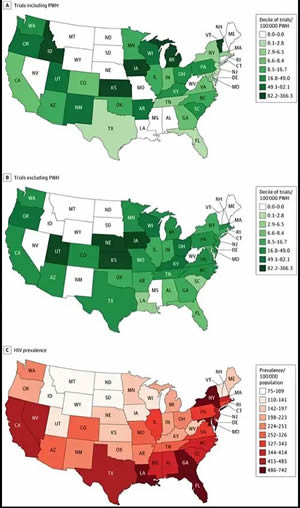
From “Geospatial Access to CAR-T Clinical Trials for Non-Hodgkin Lymphoma for Persons With HIV,” Maps of Prevalence of Trials by HIV Inclusion and/or ExclusionA and B, Color density in the key for each range is based on deciles of trials per 100 000 persons with HIV (PWH) calculated for trials that included PWH.
The study was co-led by Matthew Sisk, director of C-GALL and associate professor of the practice in the Lucy Family Institute for Data & Society, and Luke Maillie, M.D., a hematology/oncology fellow at the University of Pennsylvania. Together, they brought clinical and geospatial perspectives to a question of equity in access to emerging cancer therapies.
“Access to clinical trials for CAR-T therapy is particularly important for people living with HIV, who face higher cancer mortality rates than people without HIV and for whom NHL remains a leading cause of cancer-related death,” said Maillie.
Yet 62 percent of CAR-T trials have excluded people living with HIV, highlighting their continued underrepresentation in cancer clinical research. That gap prompted Maillie, Sisk, and colleagues to examine not only whether people with HIV were eligible for CAR-T trials, but also how easily they could access those trials geographically.
Geospatial analysis uses location-based data to examine patterns and relationships across geographic areas, helping researchers understand how factors such as distance and accessibility vary by where people live.
“We know that generally there is a link between longer travel times to care and poor health outcomes. Our goal was to apply geospatial analysis to investigate how much more difficult it is for individuals with HIV to reach the nearest clinical trial than the general population,” Sisk explained.
By surveying the National Institutes of Health’s clinical trials database for all trials related to the treatment of NHL with CAR-T therapies, the researchers found that people living with HIV experienced a median travel time of 1.15 hours to the nearest CAR-T clinical trial that included them, compared with 0.84 hours for trials that excluded them. In the US South, where HIV prevalence is highest, the gap was even greater: 1.70 hours compared with 0.92 hours.
The analysis included 80 interventional CAR-T trials enrolling adults and with at least one trial site in the U.S. Of those, only 11 (13.8 percent) included people living with HIV, while 58 (72.5 percent) explicitly excluded them. Another 11 trials did not mention HIV in their eligibility criteria.
Access to HIV-inclusive trials was lower across nearly all racial and ethnic groups, income levels, insurance types, and geographic regions. Lower household income was also consistently associated with longer travel times to CAR-T clinical trials across regions.
“These findings highlight a significant gap in access to CAR-T clinical trials for people with HIV, both through exclusion from trials and longer travel times to the trials that include them,” Sisk said. “Expanding HIV-inclusive eligibility criteria and increasing access through decentralized trial sites or partnerships between academic and community centers could help reduce these barriers and ensure that this population has more equitable access to emerging CAR-T therapies.”
“Geospatial data can reveal dimensions of inequality that are difficult to see in the numbers alone,” said Ahmed Abbasi, the Joe and Jane Giovanini Professor of IT, Analytics and Operations in the Mendoza College of Business and director of the Lucy Family Institute for Data & Society. “The work of C-GALL shows how putting data on the map can help us understand not just who has access to care, but where barriers exist and how those barriers affect communities. This human-centered approach to data is central to the interdisciplinary research that we are driving within the Lucy Family Institute.”
To learn more about the geospatial research within C-GALL, please visit the Lucy Family Institute for Data & Society website.
Contact: Brandi Wampler, associate director of story development, 574-631-2632, brandiwampler@nd.edu
Contact
Brandi Wampler
brandiwampler@nd.edu
Notre Dame
Source: Notre Dame News - University of Notre Dame
https://news.nd.edu/news/hiv-patients-with-cancer-must-travel-farther-than-others-to-access-clinical-trials/
“Reproduced with permission - University of Notre Dame”
University of Notre Dame
Back to…
Positively Positive - Living with HIV/AIDS:
HIV/AIDS News
For more HIV and AIDS News visit…
Positively Positive - Living with HIV/AIDS: HIV/AIDS News Archive
|