
Study: Triple-dose regimen may permanently clear HIV in infected newborns
OHSU-led discovery in animal model could advance quickly to clinical trials in people
By Erik Robinson
Lea esta página en español
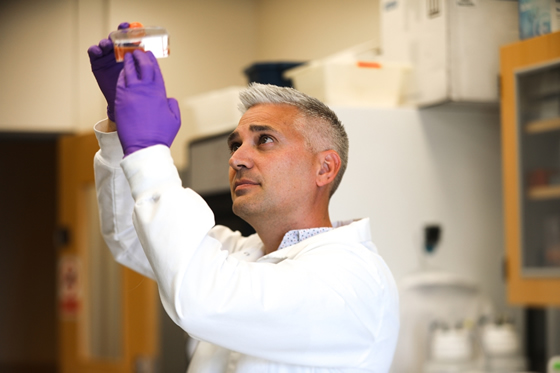
Research from the lab of Jonah Sacha, Ph.D., at OHSU, has identified a one-time regimen of therapies for newborns with HIV that, if given within three days of birth, could permanently clear the virus. The research team hopes to use the animal model results to move into a human clinical trials. (OHSU/Christine Torres Hicks)
Portland, Oregon, August 10, 2026 – Every year, more than 120,000 newborns worldwide contract HIV, a global health burden that requires lifelong treatment for millions of people — assuming they have access and can afford it.
New research led by Oregon Health & Science University suggests another possibility: a one-time regimen of therapies given to newborns within three days of birth to permanently clear the virus.
The research was published today in the journal Nature Microbiol
 Jonah Sacha, Ph.D. (OHSU)
“The really exciting part is that it could go to clinical trials immediately to eliminate HIV infection in newborns,” said co-lead author Jonah Sacha, Ph.D., professor and chief of pathobiology and immunology at OHSU’s Oregon National Primate Research Center and Vaccine and Gene Therapy Institute. “The next step after that is to test if this can work in newly exposed adults.”
The research involved many collaborators and nonhuman primates at both the Oregon and California national primate research centers.
Researchers tested three distinct treatments that were delivered for a few weeks: neutralizing antibodies, standard antiretroviral therapy, and an experimental monoclonal antibody known as leronlimab.
 Nancy Haigwood, Ph.D. (OHSU)
Each of the individual treatments has been tried previously and failed to permanently clear the virus — and Sacha wasn’t convinced combining them would work any better. Sacha has worked for years to develop leronlimab, which is designed to block HIV from entering immune cells through a surface protein called CCR5. His longtime OHSU colleague and coauthor Nancy Haigwood, Ph.D., thought combining existing therapies with leronlimab might be effective.
The study that published today shows she was correct.
Haigwood, a former professor and ONPRC director, is a virologist and immunologist who has specialized in HIV antibody research for decades.
“We were astounded and overjoyed, actually,” Haigwood said. “It’s a remarkable result.”
Antiretroviral therapy has already been approved in people, whereas broadly neutralizing antibodies and leronlimab are both being tested separately in clinical trials. This new discovery of a one-time, three-part regimen to clear the virus in newborn babies would first need to be tested in clinical trials in people — most likely in newly exposed adults initially — before it would be widely available to constrain an HIV epidemic that continues to kill 600,000 people worldwide each year.
Researchers say they are optimistic, given the anatomical similarity between nonhuman primates and people.
“There was no reason to think this would completely clear the virus,” Sacha said. “It’s one of those things where you test it and, holy cow, it works and you’ve discovered something new.”
Exactly how this approach worked remains unclear, but Sacha and Haigwood said it appears that the combination of therapies is far more potent and effective than each therapy alone. The key appears to be leronlimab’s ability to block HIV from entering immune cells through the surface protein CCR5.
“For reasons we don’t understand, HIV really wants to use CCR5 receptors to infect cells,” Sacha said. “By blocking access, it’s like you’ve kept fuel away from the fire.”
Haigwood uses a slightly different analogy:
- Turning off the faucet: Antiretroviral therapy doesn’t eliminate HIV altogether, but it minimizes its ability to replicate.
- Mopping up: Neutralizing antibodies effectively corral HIV so there is less virus circulating in the body’s blood supply.
- Sealing off: Leronlimab blocks what’s left of the virus from infecting immune cells — the equivalent of sealing off the room with a water-tight valve.
Haigwood believes the combination appears to be especially potent early in the infection.
“There’s a lot more going on during the first week of infection than we previously thought,” she said. “From this experiment, it looks like there’s a dynamic interaction between the virus and antibodies that takes place as the virus begins to spread.”
Researchers are eager to see whether the combined regimen can be effective beyond 72 hours of the initial infection.
“We only tested out to three days,” Sacha said. “Could it work a week after infection? Two weeks? How far can you go after infection, and still purge the virus?”
The research published today was supported by the National Institutes of Health under Award Numbers R01HD080459 from the Eunice Kennedy Shriver National Institute of Child Health and Human Development (NICHD); R01AI154559, R01AI166969, and R01AI129703 from the National Institute of Allergy and Infectious Diseases (NIAID); K01OD036063 from the Office of the Director (OD), NIH; P51OD011092 and U42OD010426 from the Office of Research Infrastructure Programs (ORIP), NIH, to the Oregon National Primate Research Center; and P51OD011107 from ORIP, NIH, to the California National Primate Research Center. The content is solely the responsibility of the authors and does not necessarily represent the official views of the NIH.
In our interest of ensuring the integrity of our research and as part of our commitment to public transparency, OHSU actively regulates, tracks and manages relationships that our researchers may hold with entities outside of OHSU. In regard to this research, Sacha and co-author Scott Hansen, Ph.D., have had a significant financial interest in CytoDyn, a company that may have a commercial interest in the results of this research and technology. Review details of OHSU's conflict of interest program to find out more about how we manage these business relationships.
All research involving animal subjects at OHSU must be reviewed and approved by the university’s Institutional Animal Care and Use Committee (IACUC). The IACUC’s priority is to ensure the health and safety of animal research subjects. The IACUC also reviews procedures to ensure the health and safety of the people who work with the animals. No live animal work may be conducted at OHSU without IACUC approval.
Contact:
Erik Robinson
Senior communications specialist
OHSU | Oregon Health & Science University
Direct: 503 494-7986 | Cell: 971 373-3534
Media Department: 503 494-8231
Email: robineri@ohsu.edu
Source: https://news.ohsu.edu/2026/08/10/study-triple-dose-regimen-may-permanently-clear-hiv-in-infected-newborns
“Reproduced with permission - OHSU | Oregon Health & Science University”
OHSU | Oregon Health & Science University
Back to…
Positively Positive - Living with HIV/AIDS:
HIV/AIDS News
For more HIV and AIDS News visit…
Positively Positive - Living with HIV/AIDS: HIV/AIDS News Archive
|