|
News Release
March 24, 2026
Severe infections may raise dementia risk, study finds
Finnish registry study finds that infections like cystitis and bacterial disease are linked to higher dementia risk independently of other coexisting conditions
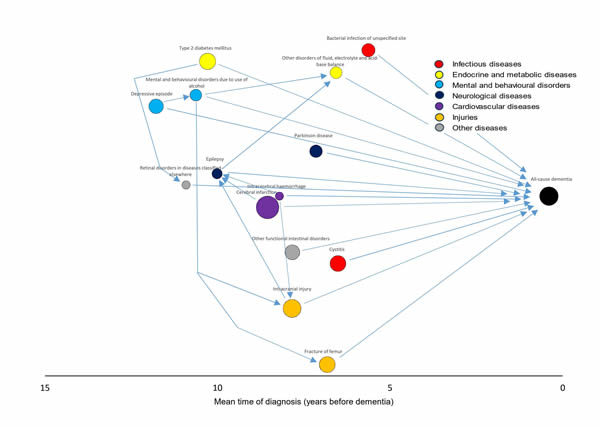
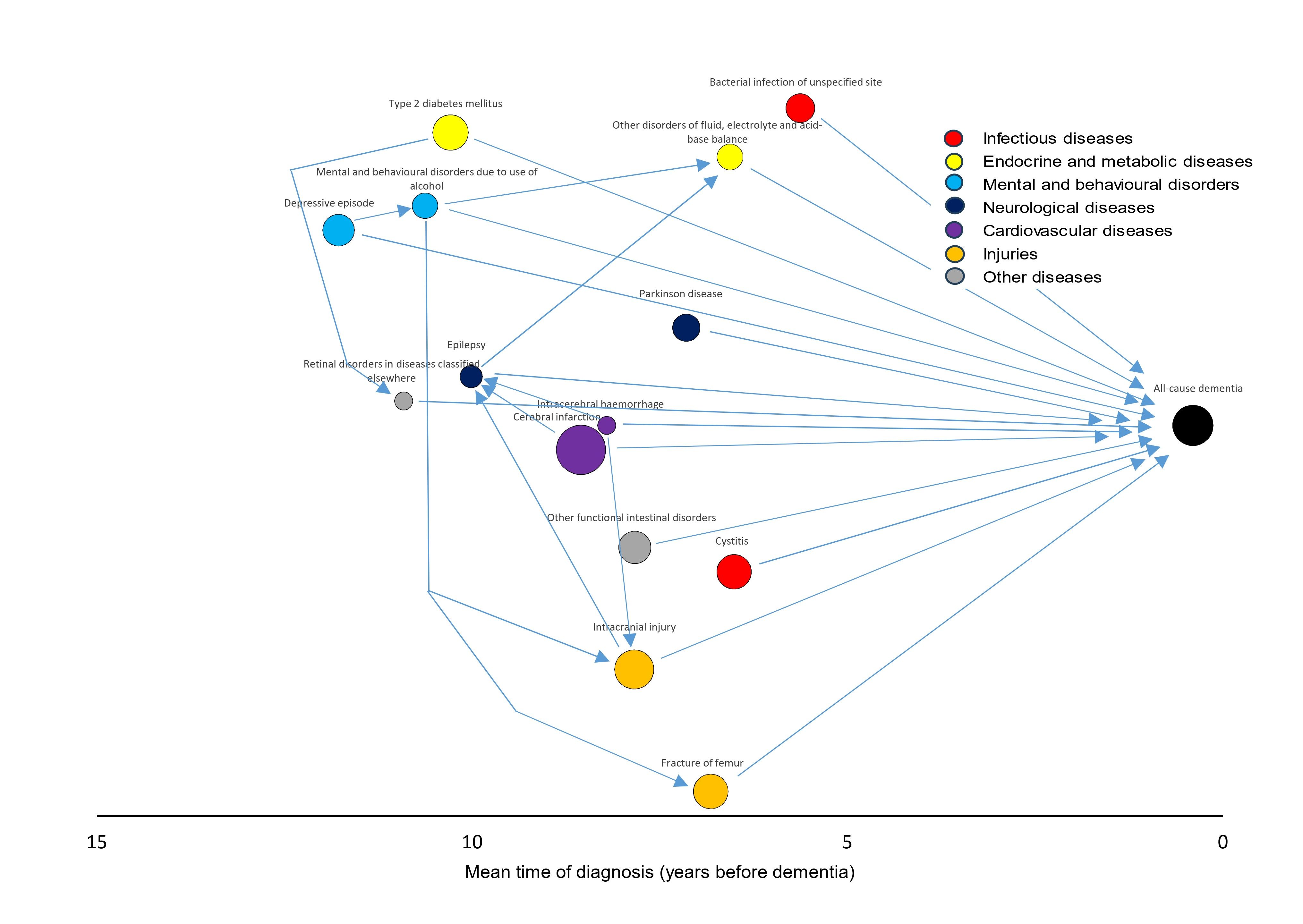
Image Caption: Associations between dementia-related diseases. For clarity, the figure illustrates associations between 14 of the 29 dementia-related diseases identified in the study (all 29 diseases are shown in Fig 4 of the paper in PLOS Medicine).
Image Credit:Sipilä PN, et al., 2026, PLOS Medicine, CC-BY 4.0 (https://creativecommons.org/licenses/by/4.0/)
Severe infections increase the risk of dementia independently of other coexisting illnesses, according to a new study published March 24th in the open-access journal PLOS Medicine by Pyry Sipilä of the University of Helsinki, Finland, and colleagues.
Severe infections have been linked to an increased risk of dementia. However, it has been unclear whether this association is explained by other coexisting, non-infectious diseases that predispose people to both infections and dementia.
In the new study, researchers used nationwide Finnish health registry data covering more than 62,000 individuals aged 65 or older who were diagnosed with late-onset dementia between 2017 and 2020, along with more than 312,000 matched dementia-free controls. Taking a broad approach, they examined all hospital-treated diseases recorded during the previous twenty years, identifying 29 diseases that were robustly associated with increased dementia risk. Nearly half (47%) of dementia cases had at least one of the 29 identified diseases before their diagnosis.
Of those diseases, two were infections: cystitis (a urinary tract infection) and bacterial infection of an unspecified site. Among the non-infectious diseases, the strongest associations with dementia were seen for mental disorders due to brain damage or physical disease, Parkinson’s disease, and alcohol-related mental and behavioral disorders.
When the researchers then adjusted for all 27 non-infectious dementia-related diseases identified, the association between both infections and dementia remained largely intact. Less than one-seventh of the excess dementia risk among individuals with hospital-treated cystitis or bacterial infections was attributable to pre-existing conditions. The link between infections and dementia was even stronger for early-onset dementia (diagnosed before age 65), where five types of infection—including pneumonia and dental caries—were associated with elevated risk.
The study was limited by the lack of baseline cognitive assessments and clinical examination data before dementia diagnoses, as well as a lack of data on infection treatments.
“Overall, our findings support the possibility that severe infections increase dementia risk; however, intervention studies are required to establish whether preventing or effectively treating infections yields benefits for dementia prevention,” the authors say.
The authors add, “We found 27 diverse severe, hospital-treated diseases that were robustly associated with an increased risk of dementia. Two of these diseases were infections, namely urinary tract infections and unspecified bacterial infections.”
“In our study, dementia-related infections occurred on average 5 to 6 years before dementia diagnosis. Given that the development of dementia often takes years or even decades, these findings suggest that severe infections might accelerate underlying cognitive decline. However, as these findings were observational, we cannot exclude the possibility that some unmeasured confounding factors might also have affected our findings. Thus, we cannot prove cause and effect.”
“Ideally, intervention trials should examine whether better infection prevention helps reduce dementia occurrence or delay the onset of this disease.”
Press preview: https://plos.io/4uAZon8
In your coverage, please use this URL to provide access to the freely available paper in PLOS Medicine: https://plos.io/4qY5nix
Contact: Pyry Sipilä, pyry.sipila@helsinki.fi
Image caption: Associations between dementia-related diseases.For clarity, the figure illustrates associations between 14 of the 29 dementia-related diseases identified in the study (all 29 diseases are shown in Fig 4 of the paper in PLOS Medicine).
Image credit: Sipilä PN, et al., 2026, PLOS Medicine, CC-BY 4.0 (https://creativecommons.org/licenses/by/4.0/)
High-resolution image link: https://plos.io/40Wdba4
Citation: Sipilä PN, Korhonen K, Lindbohm JV, Kivimäki M, Martikainen P (2026) The role of noninfectious comorbidities in the association between severe infections and risk of dementia in Finland: A nationwide registry study. PLoS Med 23(3): e1004688. https://doi.org/10.1371/journal.pmed.1004688
Author countries: Finland, United States of America, United Kingdom, Germany
Funding: see manuscript
Competing interests: The authors have declared that no competing interests exist.
About PLOS Medicine
PLOS Medicine publishes high-impact research that transforms healthcare delivery, shapes policy, and advances clinical understanding. Our scope encompasses critical challenges in global health—from major diseases to health equity and the social determinants of health—with emphasis on work that bridges research and real-world implementation.
The journal serves as a trusted platform where rigorous methodology meets practical impact, connecting researchers, healthcare professionals, and policymakers via collaborative editorial support to drive meaningful improvements in global health outcomes.
Media and copyright information
For information about PLOS Medicine relevant to journalists, bloggers and press officers, including details of our press release process and embargo policy, visit https://plos.org/media/.
PLOS journals publish under a Creative Commons Attribution License, which permits free reuse of all materials published with the article, so long as the work is cited.
About PLOS
PLOS is a non-profit organization on a mission to drive open science forward with measurable, meaningful change in research publishing, policy, and practice. We believe in a better future where science is open to all, for all.
Building on a strong legacy of pioneering innovation, PLOS continues to be a catalyst in open science, reimagining models to meet open science principles, removing barriers and promoting inclusion in knowledge creation and sharing, and publishing research outputs that enable everyone to learn from, reuse, and build upon scientific knowledge.
Disclaimer
This press release refers to upcoming articles in PLOS Global Public Health. The releases have been provided by the article authors and/or journal staff. Any opinions expressed in these are the personal views of the contributors, and do not necessarily represent the views or policies of PLOS. PLOS expressly disclaims any and all warranties and liability in connection with the information found in the release and article and your use of such information.
Source: https://journals.plos.org/globalpublichealth/article?id=10.1371/journal.pgph.0001996
"Reproduced with permission - PLOS"
PLOS
Back to…
Positively Positive - Living with HIV/AIDS:
HIV/AIDS News
For more HIV and AIDS News visit…
Positively Positive - Living with HIV/AIDS: HIV/AIDS News Archive
|